
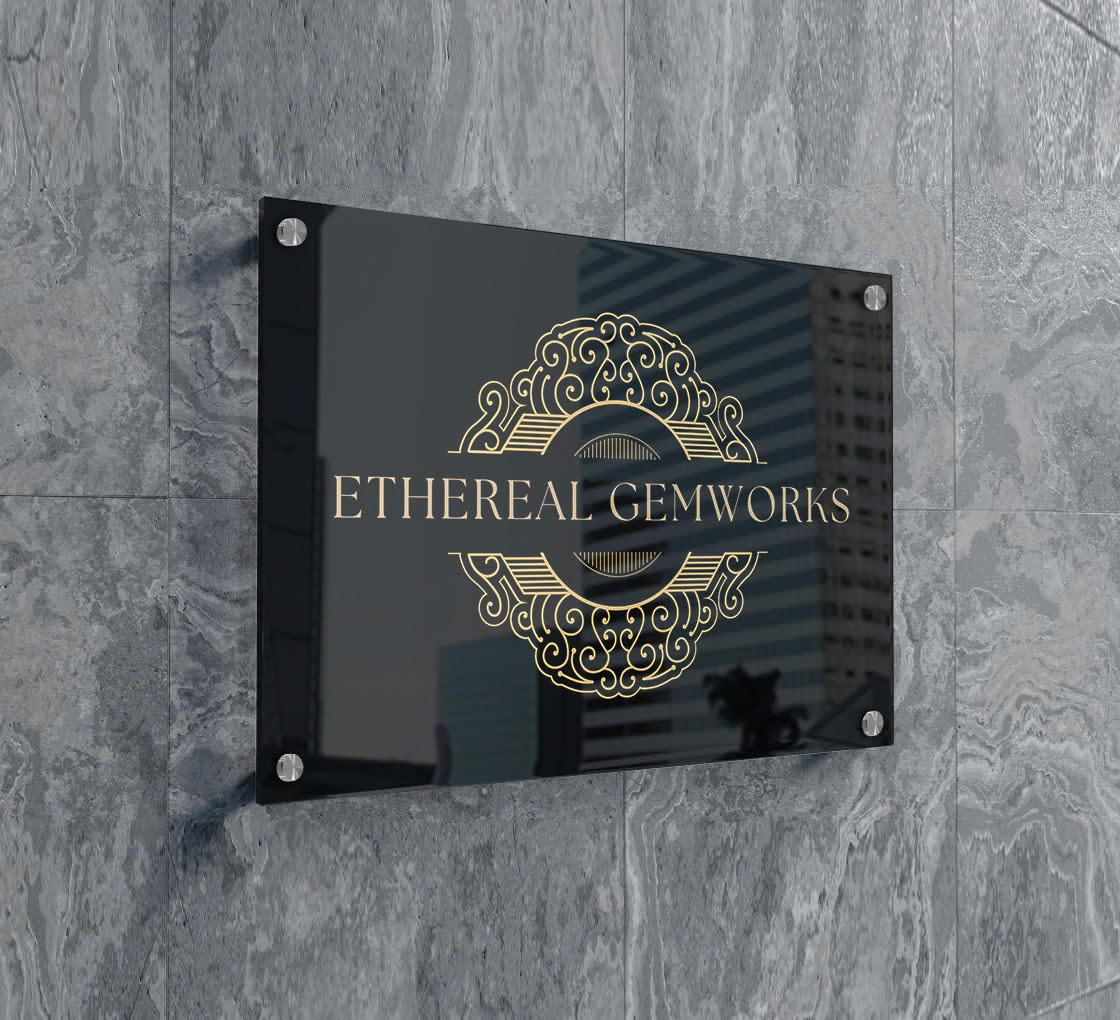
A quote for custom acrylic signage is built in a fixed order: the sheet is chosen, the parts are cut, the edges are finished, and the sign is assembled and installed. Each stage depends on the one before it, so an early decision about grade, thickness or dimensions sets the cost of everything after it.
The main cost drivers are materials, machine time, hand labor and the site itself. Understanding that sequence makes it easier to see which changes will lower a quote and which will raise it.
The artwork comes before the sheet
The first line item appears before any material is ordered: the artwork has to be machine-ready. A production-ready vector file, such as an EPS or DXF, goes straight to the nesting software and the router. A low-resolution JPEG doesn’t go to the router; it has to be rebuilt as clean vector paths first, and that reconstruction is billed as design labor. Supplying good files removes a line item that catches many buyers out.
Materials set the baseline cost
Acrylic sheet comes in two grades, and the gap between them is where a quote starts. Cast acrylic is the higher grade, with better optical clarity and cleaner machining. It also resists the fine surface cracking known as crazing. Extruded acrylic is mass-produced and cheaper to buy, but it is softer and carries more internal stress, which makes it prone to melting on the cutter.
Those differences show up later in the job. A sheet that melts on the router takes longer to cut and leaves edges that won’t take a polish. Internal stress appears as crazing when the sheet is solvent-bonded or heat-bent.
Cast acrylic costs more per sheet because it avoids those problems. Fabricators choose it for jobs with deep machining or polished edges, since it behaves predictably under the cutter and takes a flame-polished edge well, so it suits display pieces seen up close. Extruded has its own working advantages, including tighter thickness tolerance and easier thermoforming. Which grade belongs outdoors depends on the product specification, not the manufacturing method alone, so the datasheet for the sheet in question settles that question.
For indoor signs, short-term displays and flat panels, extruded is often the sensible buy because weather exposure is less of a consideration. For anything facing the weather, the grade decision carries real commercial weight. A sign that yellows or cracks within a few years loses the customer’s confidence, and the saving from a cheaper sheet goes with it.
Thickness and sheet size scale the spend
Once the grade is set, thickness is the next multiplier. Acrylic is sold by the sheet, and the price per sheet climbs steeply as the gauge moves from 3mm up to 10mm or 20mm. A 3mm panel suits a flat indoor sign, while 10mm or 20mm stock gives cut letters their heavy, architectural look. Thicker material cuts more slowly and weighs more, so the gauge adds machine time and calls for sturdier mounting hardware later.
Sheet yield is the other half of the calculation. One standard sheet size is 2440 mm by 1220 mm, and fabricators use nesting software to arrange letters and panels on that sheet so the least area is wasted. If the quote charges for a full sheet, offcuts from an awkward size add to material waste.
A design that sits just over the sheet width pushes a few parts onto a second sheet. Pulling the overall dimensions back by a few centimeters, so everything nests on one sheet, is one of the easiest savings available. Ask the fabricator to check the design against stock sheet sizes before quoting so there is time to make small adjustments.
Color, finish and outdoor exposure
Clear acrylic is the baseline for pricing. Solid colors, frosted finishes, matte surfaces and metallic sheets all cost more, because they are made in smaller runs and stocked in fewer thicknesses. Specialty sheets can also carry longer lead times, which affects the schedule as well as the price. Branded material sits above unbranded stock as well: Perspex, for example, is produced to strict quality standards and carries long-term outdoor warranties.
Color can also be added after the sheet is cut. Vinyl graphics, in polymeric or cast films, are applied to the acrylic surface to reproduce multi-color logos and fine text that can’t be cut from a single sheet. The cost depends on the grade of film and how much of the panel it covers, and the high-performance cast films last longest outdoors. Vinyl also lets one clear panel carry several colors, which keeps the sheet bill down on logo-heavy designs.
The installation site determines how much the material warranty is worth. UV degradation is the chemical breakdown of plastic under solar radiation, and it shows up as yellowing and brittleness before colors start to fade. An unbranded sheet with no UV guarantee can look tired within a few summers, and replacing the sign then costs more than the original saving.
On exposed coastal sites, the signage perth businesses order faces this calculation in a harsher form, because heat and coastal conditions speed the wear up. A regional fabricator that uses UV-guaranteed materials and high-precision CNC machining gives the sign its best chance of a long service life.
Machining time and edge finishing
With the sheet chosen, the quote moves to machine time. CNC routing is a computer-controlled process that cuts precise 2D and 3D shapes, letters and rebates straight from thick acrylic sheet. Once the toolpaths are set, the time spent cutting helps determine the machining charge. Tight curves, fine detail, rebates and engraved work all add passes, and every pass is charged time.
The edge finish is where hand labor takes over from the machine. A standard machined edge is quick and suits most indoor work. Polished edges are usually specified on thick, clear letters where the edge is part of the look.
A glass-like edge can call for a separate finishing step after routing. Flame polishing can brighten a machined edge quickly, and curved or internal edges may need slower hand work.
Solvent bonding and heat bending add more skilled hours. A bonded case has to be jigged and glued, then cured before it can be handled, and each step is billed as workshop time. The grade decision matters here too, because extruded acrylic’s tendency to melt makes it slower to cut and harder to finish cleanly.
Flat-cut letters and dimensional lettering price differently
Fabrication style is where quotes diverge most. Flat-cut letters are sliced from sheet in one pass, cleaned up and fixed to the wall on spacers or standoff mounts that hold them off the surface. The work is mostly machine time, and assembly is quick.
Dimensional lettering is assembled from parts. A 3D letter has a face, shaped returns that give it depth, a backing panel and internal fixings. The returns are heat-bent to match the face exactly, then bonded by hand, and one channel letter can take hours of bench work before it is ready to mount. A full set multiplies that time across every character, and letters built to stand off a sign tray add the tray itself to the material list.
The question is whether the depth justifies the extra work. Flat letters on standoffs give a floating, finished look with a fraction of the assembly hours, and for many shopfronts that’s enough. Where the sign has to read from a distance or carry lighting, the extra depth is worth the cost.
Illumination adds components and labor
Lighting turns a fabrication job into an electrical one. Illuminated signs use LED modules, which run on low voltage and draw little power, but the modules bring a parts list of their own. Outdoor signs need waterproof, IP-rated modules, the letters need diffusers so the light spreads evenly without hotspots, and the system needs power supplies and internal wiring. Diffusers matter most in shallow letters, where the modules sit close to the face.
The labor is the larger cost. Each module is wired and tested by hand inside the letter before it’s sealed, and power supplies have to be housed where they can be reached later. Final connections are often made by an electrician, which adds another trade to the schedule.
Buyers can protect themselves on timing. The lighting decision has to be made before fabrication starts, because it sets the letter depth and the wiring routes. Adding light to letters already built as flat cutouts means remaking parts, which costs far more than deciding early.
The site sets the installation price
Installation is priced on the conditions of the site. Standoff mounts into brick or masonry mean drilling and anchors, and a panel mounted high on a facade can need a scissor lift booked for the day. Access equipment hired by the day makes delays expensive, so installers plan around weather and access windows.
Large outdoor signs can require structural engineering checks, so the sign and its fixings will withstand local wind loads. Difficult surfaces call for backing plates and specialist fixings. A site visit, or photos and measurements sent with the artwork, lets the fabricator price the whole job in one pass and avoids variations on the day.
Where the savings actually sit
Material choice and fabrication style produce the widest price gaps, so they deserve the most attention. Trimming the design to fit one sheet and matching the grade to the exposure will do more for the budget than any negotiation at the end.
The practical sequence is straightforward. Settle the size against the standard sheet, pick the grade for the site, decide on lighting before anything is cut, and send vector artwork with photos of the wall. Changes made after cutting starts are the expensive ones, because every later stage is already committed. A fabricator working from that information can give a more dependable quote.